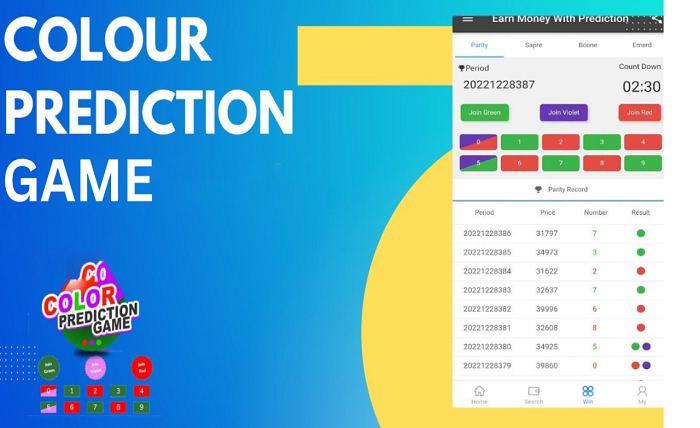
Tiranga Games are online mobile-based platforms where users choose a colour option, wait for a short time, and see whether their prediction matches the final result. These games look simple on the surface, but they follow a structured system that runs continuously in short rounds.
To understand them properly, it is important to break down how they function, what happens behind each round, and why outcomes cannot be easily predicted.
What Are Colour Prediction Games?
Colour prediction games are digital games where users select one option from a set of colours and participate in timed rounds. The most common colours are usually:
- Red
- Green
- Violet (or mixed result depending on platform)
Each round has a fixed time cycle, and after the countdown ends, a result is displayed.
Users either win or lose based on whether their selected colour matches the outcome.
Basic Working Structure
The system works in a repeating cycle:
- A round starts with a timer
- Users place their selection (colour choice)
- The timer ends
- The system generates a result
- Winners and losers are determined
- Next round begins immediately
This cycle continues repeatedly throughout the day.
How Results Are Generated
One of the most important aspects is how results are created.
Although different platforms may use different internal systems, the general idea is:
- Each round is independent
- Results are generated within a fixed system
- Outcomes are not influenced by previous rounds
- Timing and selection windows are strictly controlled
Because of this structure, results change quickly and cannot be reliably predicted based on past outcomes.
Why People Think Patterns Exist
Many users believe they can identify patterns such as:
- Red repeating multiple times
- Alternating sequences like red-green-red
- Sudden appearance of violet
- Short winning streaks
While these patterns may appear temporarily, they are not fixed rules. They are part of random variation within the system.
This is why predictions based only on patterns often fail.
Role of User Participation
Users play a simple role in the system:
- Choose a colour before the timer ends
- Confirm their selection
- Wait for result
- Receive outcome based on match
The game is designed for fast decision-making and repeated participation.
Wallet and Entry System
Most colour prediction games use a wallet system.
Typical flow:
- User adds money to wallet
- Selects amount for each round
- Places prediction
- Wins or loses based on result
- Balance updates automatically
The wallet acts as the central system for participation.
Why Results Cannot Be Predicted Easily
There are several reasons why prediction is difficult:
- Each round is independent
- No fixed pattern guarantees repetition
- Outcomes are generated within a controlled system
- Timing cycles are fast and unpredictable
Because of this, relying on guesswork or patterns is not reliable.
Common Misunderstandings
Many beginners believe:
- There are secret tricks to win every time
- Previous results decide future outcomes
- Apps or tools can predict results
- Certain colours are “due” to appear
In reality, these assumptions are not accurate because the system does not follow predictable cycles.
Risk Factor in Colour Prediction Games
Since these games involve chance-based outcomes, there is always risk involved.
Key points:
- Losses can happen frequently
- No guaranteed winning method exists
- Emotional decisions increase mistakes
- Continuous play can lead to losses
Understanding risk is important before participating.
Responsible Way to Understand These Games
A balanced approach includes:
- Learning how rounds work
- Observing before participating
- Avoiding emotional decisions
- Understanding that outcomes are uncertain
- Not depending on predictions for income
This helps maintain control and avoids unrealistic expectations.
Final Thoughts
Colour prediction games like Tiranga are simple, fast-paced systems based on timed rounds and random outcomes. While they appear easy to understand, the actual results are not predictable through patterns or shortcuts.
The most important thing for any user is to understand the structure, recognize the risks, and approach them with awareness rather than expectation.
FAQs
Question: What are colour prediction games?
Answer: They are online games where users choose a colour and wait for a timed result.
Question: Can results be predicted?
Answer: No, results are not reliably predictable.
Question: Do past results affect future rounds?
Answer: No, each round works independently.
Question: Why do people see patterns?
Answer: Patterns appear randomly but are not fixed or guaranteed.
Question: Is there a safe way to play?
Answer: Yes, by understanding risks and avoiding emotional decisions.